
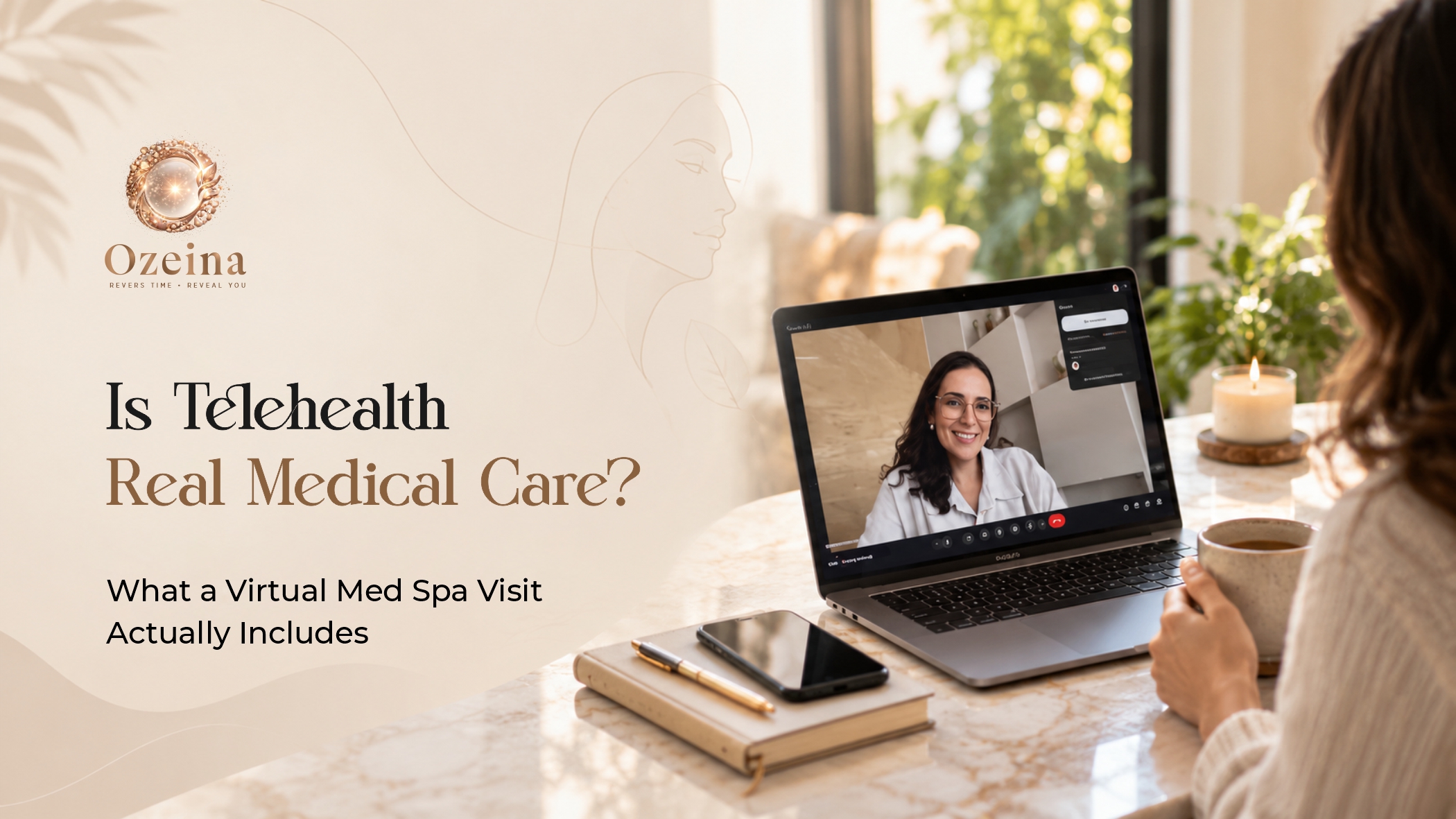
You can book a doctor’s appointment from your couch, discuss your health concerns on a video call, and potentially receive a personalized treatment plan without driving across town.
But if you’re considering a virtual med spa visit, you might still be wondering: Am I actually receiving medical care, or am I just talking to someone online?
It’s a fair question, especially when the conversation involves weight management, hormones, peptide therapy, or other treatments that deserve proper medical oversight.
Yes, telehealth can be real medical care. The important distinction is whether your visit includes an appropriate clinical assessment, a qualified healthcare professional, and a plan for follow-up—not simply an online questionnaire followed by a product recommendation.
For people exploring a telehealth med spa in Tampa, FL, virtual care can make certain parts of the process more convenient while allowing in-person appointments when an examination or procedure requires them.
At Ozeina, the idea is to make personalized medical aesthetics, wellness, and longevity care more accessible through a combination of in-clinic services and telehealth where appropriate.
Here’s what a virtual visit can actually involve, what it cannot replace, and how to tell whether a provider takes your health seriously.
A virtual med spa visit is a remote consultation with a healthcare professional to discuss appropriate aesthetic, wellness, or medical treatment options.
Depending on the service and your clinical needs, the appointment may involve reviewing your health history, discussing symptoms or goals, evaluating relevant medical information, and determining whether additional assessment is necessary.
It is not a guarantee that you’ll qualify for a particular treatment or receive a prescription.
For example, someone interested in weight management may need a different assessment from someone seeking hormone-related care. A person asking about peptide therapy may need a detailed discussion of the evidence, safety concerns, and whether the proposed treatment is appropriate at all.
A legitimate virtual visit should leave you understanding:
The technology makes the appointment remote. It doesn’t remove the need for medical judgment.
One reason people hesitate to book telehealth appointments is that they don’t know what to expect. Will the clinician ask a few questions and end the call? Will they review laboratory results? Can they recommend a treatment during the first visit?
The process depends on your concerns, but here’s what a medically appropriate virtual consultation may look like.
The conversation begins with your goals and concerns.
You may want help understanding weight-management options, have questions about hormonal symptoms, or be interested in a wellness treatment.
The clinician should ask what you’re experiencing, what you’ve tried previously, and what you hope to achieve. This is also your opportunity to explain your concerns without feeling pressured to choose a particular treatment.
Your medical history can influence which options are appropriate.
Depending on the reason for your visit, the clinician may ask about existing conditions, medications, allergies, previous treatments, relevant family history, and other factors that could affect safety.
A video consultation does not provide every measurement or examination possible in a clinic. If important information is missing, the clinician may need additional records, measurements, laboratory results, or an in-person assessment.
Not every consultation requires bloodwork. However, certain concerns may call for laboratory testing before a treatment decision can be made.
For example, a clinician evaluating possible hormonal concerns may determine that specific laboratory tests are appropriate. The tests depend on your symptoms, history, and clinical assessment rather than a universal panel for every patient.
Ask practical questions:
Testing should support a clinical decision, not simply create a longer list of services.
Once the available information has been reviewed, the clinician can discuss potential next steps.
These might include lifestyle recommendations, additional evaluation, an in-person appointment, continued monitoring, or a treatment option when medically appropriate.
A prescription is not automatic. The clinician must determine whether a treatment is suitable, consider contraindications, and follow applicable prescribing requirements.
You should also have an opportunity to discuss potential side effects, alternatives, limitations, and what to do if you experience a problem.
Medical care shouldn’t end when the video call does.
Depending on the treatment, follow-up may involve reviewing laboratory results, checking symptoms, monitoring response, adjusting a plan when appropriate, or arranging an in-person examination.
Before finishing your appointment, make sure you understand who to contact with questions, how follow-up is arranged, and what symptoms may require urgent medical attention.
A good virtual visit should leave you with a clear next step—not more uncertainty.
Telehealth can support several types of medical consultation, but the exact services available depend on the provider, your location, clinical suitability, and applicable regulations.
A telehealth weight loss clinic may offer remote consultations to assess weight-management goals, review relevant medical history, discuss lifestyle factors, and determine whether further testing or treatment is appropriate.
If prescription medication is being considered, the clinician must evaluate whether it is suitable for the individual patient. Remote care should not mean automatic prescribing.
People searching for semaglutide telehealth or tirzepatide telehealth often want to understand whether they can discuss medication-based weight management without attending every appointment in person.
A telehealth consultation may allow a clinician to assess your history, discuss potential benefits and risks, review eligibility, and determine what additional evaluation is needed.
However, not every patient qualifies, and a consultation does not guarantee a prescription. Medication availability, FDA-approved indications, prescribing requirements, and the legal status of any compounded product are separate considerations.
The FDA provides information about the risks associated with compounded semaglutide and tirzepatide. Patients should understand that compounded medications are not FDA-approved in the same way as FDA-approved drug products.
HRT Telehealth consultations may provide a convenient way to discuss symptoms that could be associated with hormonal changes.
A clinician may review symptoms, medical history, relevant testing, and individual risk factors before deciding whether further evaluation or treatment is appropriate.
Hormone therapy is not suitable for everyone, and different hormones and treatment indications have different considerations. Some patients may require an in-person examination or additional specialist care.
People researching telehealth peptide therapy or telehealth services for peptide therapy should understand that the word peptide describes a broad category of substances—not one standardized treatment.
Different peptides have different evidence bases, safety considerations, regulatory statuses, and medical uses. Some products marketed for recovery, performance, or longevity have limited human evidence and may not be FDA-approved for the advertised purpose.
A responsible consultation should explain those limitations rather than treating every peptide as an established therapy. Whether any specific treatment is appropriate or legally available must be evaluated individually.
Telehealth is useful, but it has limits. A responsible provider should tell you when remote care isn’t enough.
| Service or situation | Why in-person care may be needed |
| Botox and dermal fillers | Injectable procedures require appropriate in-person assessment and administration by a qualified professional |
| Detailed physical examination | Some findings require hands-on examination or measurements that cannot be obtained reliably by video |
| Certain diagnostic concerns | Symptoms may require imaging, laboratory testing, or an in-person examination |
| Complications or urgent symptoms | Some problems require immediate physical assessment or emergency care |
| Treatments requiring procedures | The procedure must be performed in a suitable clinical setting by an appropriately qualified professional |
For example, a virtual consultation can help you discuss your goals for Botox or fillers and understand potential options. However, the injections themselves require an appropriate in-person appointment.
Likewise, a clinician may begin a weight-management or hormone-related assessment remotely but determine that an examination or additional testing is necessary before proceeding.
The right question isn’t whether everything can be done virtually. It’s whether the provider knows when virtual care is appropriate and when it isn’t.
Privacy is a legitimate concern when discussing personal medical information online.
A healthcare provider should explain how appointments are conducted, how your information is handled, and how you can access relevant records. In the United States, HIPAA may apply to covered healthcare providers and their business associates, while other privacy requirements may also be relevant.
Before your appointment, consider these practical steps:
A provider should be willing to answer reasonable questions about privacy rather than dismissing them.
Not all online healthcare experiences offer the same level of clinical oversight. Before booking, look for these seven signs.
The provider should identify the healthcare professional responsible for your consultation and explain their credentials and role.
If the website doesn’t make it clear who evaluates your case, ask before sharing sensitive information.
A legitimate clinical assessment considers your health history, symptoms, medications, and relevant risks. A process that recommends the same treatment to everyone without meaningful evaluation deserves scrutiny.
If laboratory tests are recommended, you should understand why they’re needed, who interprets the results, and how the findings may affect your care.
A clinician should be willing to explain why a requested treatment may not be appropriate. Guaranteed prescriptions without a meaningful clinical assessment are a warning sign.
Every treatment has limitations. You should receive appropriate information about possible side effects, alternatives, expected monitoring, and when treatment should be avoided.
Ask what happens after your consultation. You should understand how to obtain results, ask questions, and arrange further assessment when necessary.
You should know whether additional appointments, testing, in-person procedures, or other services may be required. The clinic should also explain relevant fees and how appointments are arranged before you commit.
These checks are useful whether you’re considering a virtual weight-management consultation, hormone evaluation, or a conversation about aesthetic services.
Not every health or aesthetic concern needs the same type of appointment. That’s why understanding the relationship between virtual consultations and in-clinic care matters.
Ozeina offers a combination of medical aesthetics, wellness, and longevity services, with in-clinic care and telehealth available where appropriate.
A virtual consultation can be a starting point for discussing your goals and understanding possible next steps. Depending on your needs, that may lead to further evaluation, laboratory testing, a follow-up consultation, or an in-person visit.
For aesthetic treatments such as Botox and fillers, the appropriate in-person assessment and procedure remain important. A virtual conversation can help you prepare, ask questions, and understand the options before deciding whether to proceed.
For medical concerns involving weight management, hormones, or peptide-related questions, the clinician must determine what assessment and treatment options are appropriate for your individual situation.
The benefit of a hybrid approach is flexibility without pretending that every service can—or should, be delivered remotely.
A little preparation can help you get more out of your consultation.
You don’t need to arrive with a self-diagnosis or know which treatment you want. Your role is to explain your concerns; the clinician’s role is to assess them and discuss appropriate options.
If you’re looking for a telehealth med spa in Tampa, FL, convenience is only one part of the decision. You also need to understand whether the service is appropriate for your location and medical needs.
Florida has specific requirements governing telehealth practice. The applicable rules may depend on the clinician, the service, and whether the provider is licensed or otherwise authorized to practice in Florida.
Generally, patients should be prepared to confirm where they will physically be located during a virtual appointment. Providers must determine whether they are authorized to deliver the requested service to a patient in that location.
For Tampa and Riverview residents, a virtual consultation may offer a convenient starting point, while an in-person appointment can be arranged when the service or clinical assessment requires it.
You shouldn’t have to guess what happens during a medical consultation or wonder whether your concerns will receive proper attention.
A virtual visit should help you understand your options, ask questions, and determine whether telehealth, an in-person appointment, or a combination of both makes sense for your needs.
Whether you’re exploring weight management, hormone-related concerns, peptide therapy questions, or aesthetic treatments, the first step is understanding what care is appropriate for you.
Book Your Appointment with Ozeina to discuss your goals and learn which consultation options may be suitable for your needs in Tampa and Riverview.
Yes. Telehealth can provide legitimate medical care when a qualified healthcare professional conducts an appropriate assessment, makes clinically informed decisions, and provides suitable follow-up. Some conditions and procedures still require in-person care.
A virtual med spa visit may include a discussion of your goals, medical history, medications, symptoms, and previous treatments. Depending on your needs, the clinician may recommend laboratory testing, discuss treatment options, arrange follow-up, or determine that an in-person appointment is necessary.
Injectable treatments such as Botox and dermal fillers require appropriate in-person assessment and administration. Other services may also require a physical examination or procedure. A virtual consultation can help determine the appropriate next step.
Healthcare providers should use appropriate systems and safeguards to protect patient information. HIPAA may apply to covered providers and their business associates. Patients should ask how records and communications are handled and use a private setting for appointments.
Ozeina offers telehealth where appropriate alongside in-clinic services. Availability depends on the service, clinical suitability, and applicable requirements. Contact Ozeina to confirm whether a virtual consultation is suitable for your needs and location.